Monday, May 14, 2012

Inviting you to a special ONE DAY ONLY show of work from the IMB residency this Friday!

The Institute of Molecular Bioscience

is hosting a show of

Artworks by Sophie Munns this Friday, May 18


In honour of the first ever International Fascination of Plants Day this Friday, May 18th, The University of Queensland's Institute for Molecular Bioscience is presenting a show of artwork by Sophie Munns on completion of a 3 week residency collaborating with Scientist Dr Joshua Mylne. 


About: Three weeks has provided a rich and timely introduction to the field of Molecular Plant Science through dialogue and observation, journal keeping, photography, drawing and painting. Communications onsite aided this steep yet stimulating challenge to absorb new learning, in what was for the artist, an entirely unfamiliar realm of Plant Science.


When:  10am till 4pm, Friday 18th of May. 


Where: Building 80, Institute of Molecular Bioscience, University of Queensland.
              Sitemap available through IMB website here.


Why: 
Learn more about this recent undertaking and how it came about at this April post. Whilst on residency at the KEW Millennium Seedbank in the UK last October the immensity of knowledge around past endeavours in Plant Science only became more obvious as did the current "explosion" of developments in contemporary Plant Science ... bringing so many more questions to light, and  provoking a new determination to learn more at first hand, wherever possible. 
Sophie has considered at length the way in which simplified arguments descend into polarised thinking around some areas of Plant Science... tending to block rather than foster community understanding... all the while increasing a sense of alarm about the future by focusing single-mindedly on the food we eat - whether it's GM or Organic, rather than fully considering the delicate balance needed for competing needs to be addressed - habitats, soil, water, shelter, energy and all the systems that make up daily life. Building bridges between the scientists and general public is more essential than ever to actively engage the community imagination to see the layers of systemic changes needed to make societies work more effectively into the future and therefore to find new and more empowered ways of participating in matters of concern and interest.


Alongside the Exhibition at the IMB this Friday is a Public Lecture event:  
                                                 NOW FULLY BOOKED 
                                         (* an audio recording of the lecture will be made available on this site asap)

 
"Plants – and the future of global food security"
A free public lecture by author, journalist, editor and science communicator -- Julian Cribb
Friday, 18 May 2012
12 midday – 1.00 pm
VENUE
'Qld Bioscience Precinct Seminar Room'
(Building 80 – entrance via Chancellor Place, St Lucia Campus)

"Lecture fully booked* "
Tel: (07) 3346 0553

(* an audio recording of the lecture will be made available on this site asap)


All are welcome for this one-day Art showing at the IMB... so do come along and discover what it's all about this Friday if you are able to make your way to UQ. The Bus terminal is outside the IMB ... also not too far is the Citycat terminal on the river! 
For those unable to attend Images will be added to the website and blogs with prints of some works available for purchase.


Visit the NEW tumblr blog celebrating Fascination of Plants Day which was set up on the weekend.


On a personal note...
         Welcome and thank you to all the new subscribers... its been a frantic few weeks and I look forward to catching up with many in the blogging community after this weekend.
Ciao,
Sophie


PS: a brief E-news bulletin will go out tomorrow!

Tuesday, May 1, 2012

Haeckel, the Tree of Life and a new vocabulary


When I say a new vocabulary I speak for myself only as readers here may come from varied backgrounds with some of you entirely familiar with terms I'm slowly discovering, and hopefully absorbing, on this current residency and winding pathway through the diverse realm of Plant Science.

Artists are frequently                                                                                                                             drawn to images by Ernst Haeckel, although perhaps not this diagram.

File:Haeckel arbol bn.png
Genealogical tree suggested by Haeckel (1866)


Here's a link to a book written by Haeckel, translated from German which you may like to take a look at: 
Haeckel

                           A Visit to Ceylon   by Ernst Haeckel  translated by Clara Bell 1883


Photobucket
Found here.

For an excellent brief pictorial introduction read more here.

Ernst Haeckel's recapitulation theory


Genealogical tree suggested by Haeckel (1866)
During the late 19th century, Ernst Haeckel's recapitulation theory, or biogenetic law, was widely accepted. This theory was often expressed as "ontogeny recapitulates phylogeny", i.e. the development of an organism exactly mirrors the evolutionary development of the species. Haeckel's early version of this hypothesis [that the embryo mirrors adult evolutionary ancestors] has since been rejected, and the hypothesis amended as the embryo's development mirroring embryos of its evolutionary ancestors. Most modern biologists recognize numerous connections between ontogeny and phylogeny, explain them using evolutionary theory, or view them as supporting evidence for that theory. Donald I. Williamson suggested that larvae and embryos represented adults in other taxa that have been transferred by hybridization (the larval transfer theory).[8][9] However, Williamson's views do not represent mainstream thought in molecular biology,[10]and there is a significant body of evidence against the larval transfer theory.[11]


Finding contributions by artists who've delved into areas of scientific research on Plants is no doubt more extensive than we commonly realise. Its a huge area of endeavour now for artists but going back in time perhaps names are still coming to light and aren't so well known outside of Botany and related sciences.

Engaging blogger Velma Bolyard reminded me in her comment at the last post of something that was a key feature of my first week just gone on residency at the Institute of Molecular BioScience here in Brisbane...    

vocabulary

Without an adequate vocabulary + effort to be acquainted with the concepts its hard to progress. Whether I will find a month affords me the kind of progress I desire is another thing... but words are streaming in and being added to my list at a great rate. This crash course is being generously provided in the main by Joshua Mylne who's profile I've borrowed from the IMB website:

Plant molecular biology and genetics for human health
Josh Mylne
Plants have more to offer than food. Not only do we find them aesthetically inspiring, but they are the source of most medicines, the fibres we wear and the materials with which we build our houses. Plants can also be an ideal system for studying basic biological phenomena. We are using Arabidopsis thaliana, a model plant used by over 16,000 labs worldwide, to overcome barriers to protein drug production and to discover the mode of action for market drugs. In the first, we are examining the machinery employed by sunflower to process a small drug-like protein ring from within a much larger seed protein. We use genetic and transgenic approaches in Arabidopsis to understand and improve their ability to process these protein rings. In the second, we are using the surprisingly close relationship between plants and the malarial parasite Plasmodium falciparum to understand how an antimalarial drug works before the parasite finds a way to overcome it, which is essential if we are ever going to predict how malaria may acquire resistance to drugs in use today.
Projects include:
  • A new genetic system for studying anti-malarial drug resistance,
  • An ancient genetic origin for drug-like molecules in daisy seeds.


In addition many others have been most helpful. Research assistants to Joshua Mylne, Amy Argyros and Aurelie Chanson,  demonstrated Lab work on Friday and accompanied me to a most stimulating lecture by Robert J Henry, director of the newly formed University Institute: QAAFI  or Queensland Alliance for Agricultural and Food Innovation. I scribbled notes on ten pages during the hour-long talk and noted with keen interest his focus on indigenous plants and detailed inclusion of Biodiversity in his rationale for new directions. In fact... this talk contained numerous threads I've been following for some time, wondering how I might gain more info, especially for this state, re some of the questions that have emerged for me.

                                        -

                                Go to this page to find a flyer on the International Fascination of Plants Day... 
                                       the reason for this current collaboration organised through Joshua Mylne at the IMB.


On the Vocab list so far:

Sessile or sessility: In botanysessility (meaning "sitting", used in the sense of "resting on the surface") is a characteristic of plants whose flowers or leaves are borne directly from the stem.

Synteny:  is a newly coined term meaning "on the same ribbon"; Greekσύν, syn = along with + ταινία, tainiā = band. A concept relating to genetic linkage.


Phylogeny: This simple diagram provides a useful overview.

Image found here

and by way of comparison this more complex algorithm - above - found here.


Phylogenetics: In biologyphylogenetics (play /flɵɪˈnɛtɪks/) is the study of evolutionary relation among groups of organisms (e.g. species,populations), which is discovered through molecular sequencing data and morphological data matrices. The termphylogenetics derives from the Greek terms phyle (φυλή) and phylon (φῦλον), denoting “tribe” and “race”;[1] and the termgenetikos (γενετικός), denoting “relative to birth”, from genesis (γένεσις) “origin” and “birth”.[2]
Taxonomy, the classification, identification, and naming of organisms, is richly informed by phylogenetics, but remains methodologically and logically distinct.[3] The fields of phylogenetics and taxonomy overlap in the science of phylogenetic systematics — one methodology, cladism (also cladistics) shared derived characters (synapomorphies) used to create ancestor-descendant trees (cladograms) and delimit taxa (clades).[4][5] In biological systematics as a whole, phylogenetic analyses have become essential in researching the evolutionary tree of life.

Phylogenomics: Phylogenomics is the intersection of the fields of evolution and genomics.[1] The term has been used in multiple ways to refer to analysis that involves genome data and evolutionary reconstructions. It expands earlier phylogenetics. Phylogenomics draws information by comparing entire genomes, or at least large portions of genomes. Phylogenetics is smaller in scope and compares and analyzes only single genes, or a very small number of genes.[2] Three major areas fall under phylogenomics:
  • Prediction of gene function
  • Establishment and clarification of evolutionary relationships
  • Prediction and retracing lateral gene transfer

                                                                                                                            NB: All found at Wiki!


449725455_de2ee7141f.jpg
Image link from this blog: Bioephemera Jessica Palmer has a PhD in Molecular Biology
 and has been blogging about the intersection of art and biology since 2006. NB: image link
given by Palmer is no longer current... so here is no title or name of artist supplied.

Of course I could keep going - there's endless material I keep finding.... but its already too much informations i'm sure.
             Till next time, thanks for popping in here!
S

Thursday, April 19, 2012

What's Beatrix Potter got to do with "New Art/Science Affinities" + Announcing the NEW Project!

  What indeed you might well ask.
          Both the Beatrix Potter story and the following 'New Art/Science Affinities' article were in my e-box this morning. A curious connection jumped right out at me!
          First to Beatrix Potter... known for her tender-hearted illustrated books loved by children for a century or more. A film about 5 years ago offered a glimpse into the life of the artist... however the latest newsletter from the Linnean Society* in London announces an April event (see below) on the scientific work of Beatrix Potter that leads one to consider how light on facts about Potter the film actually was. In saying that... it's still quite an engaging film and worth viewing despite being minus some outstanding accomplishments.

Beatrix Potter: The Mycologist

Ali Murfitt & Professor Roy Watling
20th April, 14.00pm

The work of Beatrix Potter as a mycologist and scientific artist is to be celebrated at this event, to mark the centenary of the Armitt Library and Museum in Ambleside, Cumbria, which holds a considerable collection of her work. A young female mycologist, Ali Murfitt, will present a synopsis of a scientific paper which Beatrix Potter wrote in 1897, and which was presented to the Linnean on her behalf by a man; as a woman, Beatrix herself was not allowed to present the paper, or even attend. 

The paper, “On the germination of the spores of agaricineae” was returned to Beatrix, with some feedback from the Linnean Society to ready the paper for publication, the paper subsequently disappeared. However, its essence has been collated by Professor Roy Watling of the Royal Botanic Garden in Edinburgh. Beatrix eventually abandoned a scientific career when it became apparent that she would be able to earn a living from writing and illustrating The Tale of Peter Rabbit and subsequent books for children. However, her contribution to the development of mycological research is acknowledged by scientists today. A sample from the collection of Beatrix Potter’s scientific art works will be exhibited in the library on the day of the event. Professor Roy Watling will provide an introduction to Beatrix Potter's mycological studies and he will then put this in the context of mycology today.
This will be an open meeting but regsitration is essential, please visit our website for more information. There will be tea served in the Library afterwards from 3.30.

The Linnean Society of London
Burlington House
Piccadilly
London
The Linnean Society 'The cultivation of the Science of Natural History in all its branches'

The Linnean Society of London is the world’s oldest active biological society. Founded in 1788, the Society takes its name from the Swedish naturalist Carl Linnaeus (1707–1778) whose botanical, zoological and library collections have been in its keeping since 1829. As it moves into its third century the Society continues to play a central role in the documentation of the world’s flora and fauna – as Linnaeus himself did – recognising the continuing importance of such work to biodiversity conservation.

                                   A page from Beatrix Potters notebook when she was aged 8.


"At the age of eight Beatrix Potter was already studying and recording the characteristics of a wide variety of animals, birds and insects in a home-made sketchbook. This habit of spending time observing the form and structure of living things continued throughout her childhood and into adolescence." - from the Victoria & Albert Museum.
Found here.
From extensive notes found at Wikipedia: Scientific illustrations and work in mycology
Beatrix Potter’s parents did not discourage higher education. As was common in the Victorian Era, women of her class were privately educated and rarely sent to college.[20]Beatrix Potter was interested in every branch of natural science save astronomy.[21] Botany was a passion for most Victorians and nature study was a popular enthusiasm. Potter was eclectic in her tastes; collecting fossils,[22] studying archeological artifacts from London excavations, and interested in entomology. In all of these areas she drew and painted her specimens with increasing skill. By the 1890s her scientific interests centered on mycology. First drawn to fungi because of their colours and evanescence in nature and her delight in painting them, her interest deepened after meeting Charles McIntosh, a revered naturalist and mycologist during a summer holiday in Perthshire in 1892. He helped improve the accuracy of her illustrations, taught her taxonomy, and supplied her with live specimens to paint during the winter. Curious as to how fungi reproduced Potter began microscopic drawings of fungi spores (the agarics) and in 1895 developed a theory of their germination.[23] Through the aegis of her scientific uncle, Sir Henry Enfield Roscoe, a chemist and vice chancellor of the University of London, she consulted with botanists at The Royal Gardens at Kew, convincing George Massee of her ability to germinate spores and her theory ofhybridization.[24] She did not believe in the theory of symbiosis proposed by Simon Schwendener, the German mycologist as previously thought, rather she proposed a more independent process of reproduction.[25
Rebuffed by William Thiselton-Dyer, the Director at Kew, because of her gender and her amateur status, Beatrix wrote up her conclusions and submitted a paper “On the Germination of the Spores of the Agaricineae” to the Linnean Society in 1897. It was introduced by Massee because, as a female, Potter could not attend proceedings or read her paper. She subsequently withdrew it realizing that some of her samples were contaminated, but continued her microscopic studies for several more years. Her paper is lost and probably destroyed, and without it and her drawings, her discoveries can never be properly evaluated.[26][27][28] Potter later gave her other mycological drawings and scientific drawings to theArmitt Museum and Library in Ambleside where mycologists still refer to them to identify fungi. There is also a collection of her fungi paintings at the Perth Museum and Art Gallery in Perth, Scotland given by Charles McIntosh. In 1967 the mycologist W.P.K. Findlay included many of Potter’s beautifully accurate fungi drawings in his Wayside & Woodland Fungi, thereby fulfilling her desire to one day have her fungi drawings published in a book.[29] In 1997 the Linnean Society issued a posthumous apology to Potter for the sexism displayed in its handling of her research.[30]


          In contrast with Beatrix Potter's thwarted life in Science is this story below on 'Artists involved at the intersection of Art and Science' presented in a recent publication... do note the abundance of women included here.


NEW ART/SCIENCE AFFINITIES

Contributors: Andrea Grover, Régine Debatty, Claire Evans, Pablo Garcia, Thumb Projects
Published by: Miller Gallery at Carnegie Mellon University + CMU STUDIO for Creative Inquiry
Publication date: October 2011
The Miller Gallery at Carnegie Mellon University and the STUDIO for Creative Inquiry have co-published "New Art/Science Affinities," a 190-page book on contemporary artists that was written and designed in one week by four authors (Andrea Grover, Régine Debatty, Claire Evans and Pablo Garcia) and two designers (Luke Bulman and Jessica Young of Thumb).

Found here: EXCERPT FROM FOREWORD:

We launched our book sprint in order to produce a snapshot of this particular moment—and because we wanted to do it with immediacy, without distraction. The topic of this publication is the most recent manifestation of artists working in art, science, and technology, which we broadly define as work that adopts processes of the natural or physical sciences, “does strange things with electricity” (to borrow a phrase from Dorkbot), breaks from traditional models of art/science pairings, and was created within the last five years. We realize that art, science, and technology intersections have a tradition with much deeper roots than we have space to detail here (and that such histories have been given attention elsewhere), so we’ve provided in a timeline a brief subjective history of innovations, movements, and cultural events that have contributed to this tradition and led us to this moment. To be clear: this book is an effort to understand this very moment in art, science, and technology affinities, and the ways Internet culture and networked communication have shaped the practice.
—Andrea Grover
Project Lead, Warhol Curatorial Fellow at the STUDIO for Creative Inquiry and the Miller Gallery at Carnegie Mellon University

        We live in a remarkably different era to that which Beatrix Potter knew. Being rejected at Kew Gardens - despite her education, capacity and financial means - simply had to be borne. The just published book above points to the numbers of artists currently entering scientific fields in pursuit of projects formulated to investigate their chosen area of interest. Doors are now well and truly open... with enormous variation in the undertakings by artists all around the world...  and this book is at pains to outline the multiplicity of approaches. 

       A strong interest of my own over decades has been in the area of Ethnobotany which you might have read about before at this blog. In the context of societal shifts to more sustainable economies, lifestyles and habitats ethnobotanical concerns only grow more important.  
NB: Text from wikipedia - Ethnobotany (from "ethnology" - study of culture[1] and "botany" - study of plants) is the scientific study of the relationships that exist between people and plants.
Ethnobotanists aim to document, describe and explain complex relationships between cultures and (uses of) plants, focusing primarily on how plants are used, managed and perceived across human societies. This includes use for food, clothing, currency, ritual, medicine, dye, construction, cosmetics and more.[2] 
       My slowly evolving excursion into science curiously started in a 'previous' life ...when substitute teaching in secondary schools around 2001- 2007. To keep motivated, in often trying circumstances, I grabbed at textbooks and science journals and found worlds of inspiration. Tackling the teaching of science and geography instead of my usual Art-Music combo prompted me to think in different ways... or at the very least, to muse on fresh subjects. 
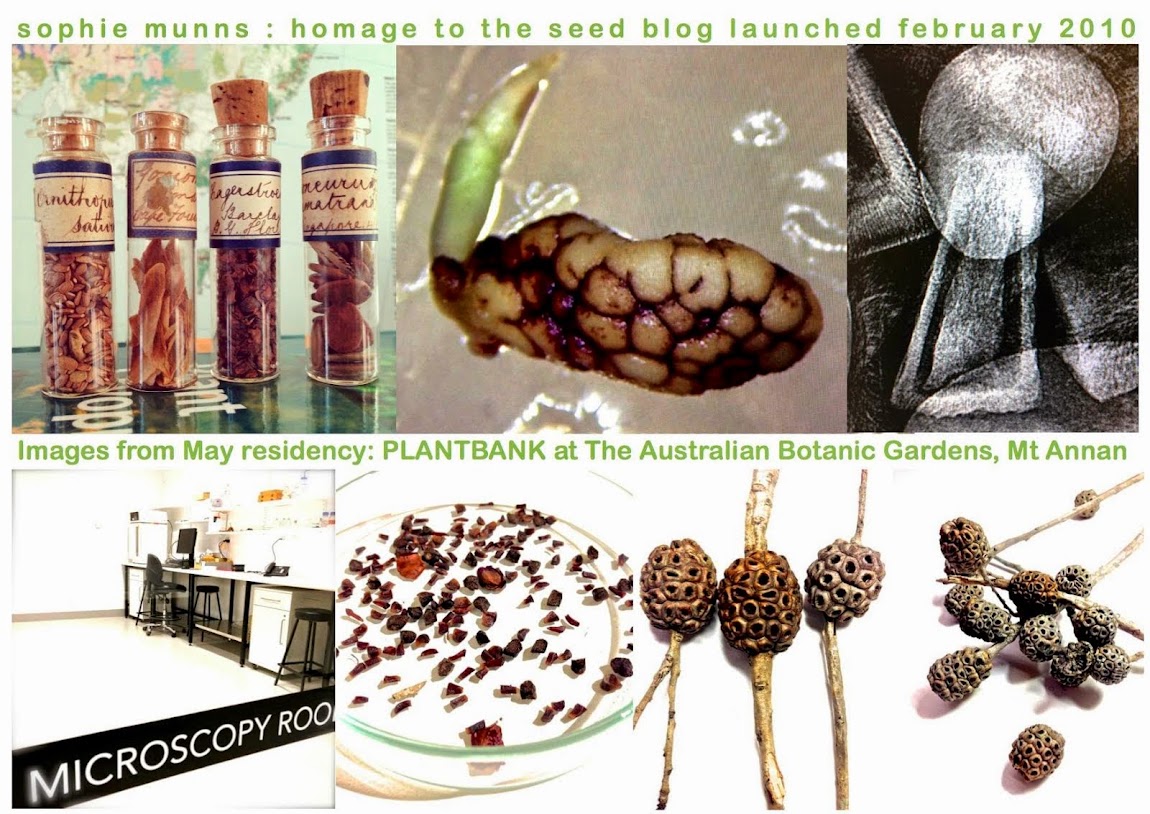
       An early fascination for past and present cultures and the vivid diversity of cultural expressions, cuisines, plants and design found stimulation in discovering fresh frameworks for thinking about people and habitats. In my art practice macro and micro focus shifted gradually from big picture abstract thinking, which resulted in large canvas artworks, to the year at Mt Coot-tha in the Seed lab where scientific perceptions and methods generated new threads to the artwork... journal pages of drawings and notes on seed species were translated into small works drawn from life as well as the more usual focus on large abstracted works.


Images from Mt Coot-tha

           Many questions arose during the 2010 residency in the Seed Lab that I am still in large part pursuing. I've since been welcomed by people in various institutes for Plant Science and continue to find it a fertile lens through which to consider where and how society and culture is evolving. 

     ANNOUNCNG THE NEW PROJECT!     
INTRODUCING THE NEXT STAGE OF THE HOMAGE TO THE SEED PROJECT:

         I returned from the UK Research Trip last November with a greater desire to fly the flag for plant science after three weeks at the Millennium Seedbank and other science institutions as diverse as the Eden Project, Natural History Museum and the Linnean Society. A visit to the John Innes Centre in Norwich, a leading plant science institute in Europe, brought much to light and through their website I read about the inaugural International Fascination of Plants Day on May 18th this year.
Fascinaton of Plants Day | May 18th 2012
        Last November I tracked down the Australian Co-ordinator to register interest in getting involved. As often happens it was put on the back burner for a time.... but in February I went back to that site and saw the inclusion of a Brisbane-based plant scientist. In late March, with May 18 looming closer, I wrote to this scientist Joshua Mylne to discuss May 18 plans and the possibility of linking up to which, I'm pleased to say, I received a most positive response. Out of that came a plan for a 21 day residency between April 16th to May 18th.... being in the same city it was possible to map out the days onsite and manage other commitments.

image: www.mylne.org
    A brilliant learning opportunity is underway through the willingness of Joshua and his team to offer this welcome, despite my coming from far outside their sphere of engagement. From the outset neither my limited knowledge of their field, approach as an artist or perceptions on seeds have been an issue. The focus is on familiarising myself with the numerous layers to the work being carried out, looking for visual clues and finding what speaks to me in the midst of it all. There is no lack of stimulation I can certainly say!
SO WHAT LED ME TO PARTICIPATE IN THIS INTERNATIONAL FASCINATION OF PLANTS DAY?
A chance viewing of a TV program on the revival of the British Food Heritage last October whilst at the MSB brought the work of the JIC Plant Science Institute in Norwich to light, which led to a visit and conversations that reinforced what I'd already gleaned at the MSB around the importance of public engagement and awareness of Plant Science.
Joshua Mylne, who also worked in the UK for a time at the JIC, got involved in this international day, essentially for quite similar reasons ... believing that education on the role of plants and plant science is absolutely crucial for the general public at this time ... not just for those inside the field.


        From the start of Homage to the Seed I've been motivated to generate conversation on seeds, plants, habitats and the systems they support and are supported by. I had little idea Science would come to preoccupy me  nor that I would see such enormous value in the the effort of engaging with Science to find the best possible information. Encounter the world through the arts is invaluable for human beings and evolving societies yet I know now I'd argue more strongly for the prism of Science as a kind of counterbalance. Its not about black and white, or right vs wrong. Someone once put it to me as a case of "and, and". And this and also that... not either/or! We need layers and complex thinking.
Conversations that took place at both the MSB and in Norwich nudged my understanding of the globally complex field of plant science and crucial distinctions between facts and fictions around the science of plants.
Negative comments about what goes on in laboratories were frequently tossed at me whilst at the Seed lab at Mt Coot-tha 2 years ago ... 
               my curiosity to find out why was sparked.
        It occurred to me then that if a Lab and the Seed bank collecting seeds from the wilderness for conservation purposes could engender so much noise and angst then were these same people rejecting all that comes from contemporary science, and all current technologies in every domain of life. 
If so that seemed at odds with choosing to remain plugged in to the goods and services in contemporary life. I found I really was curious to understand what was underneath these strong reactions in this mild and uncontroversial work I was part of at the time. After visiting the Millennium Seed Bank I was only made more aware of the relatively low technology of much they are engaged in.

image: Joshua Mylne


       The longer I considered the negative responses to seed banks, even the very idea of plant science, the more obvious it became that greater community understanding is needed.
Stronger bridges between science and community are necessary as science steps up to deal with the human impact on nature in a multiplicity of ways. Lively dinner conversations at the Millennium Seedbank with researchers hailing from several continents left me in no doubt as to the levels of scientific monitoring required to formulate ways of responding to the complex conditions arising that are already affecting biodiversity of plants, animals and ecosystems as well as lifestyles. 
     In the 90's I chewed a lot of ears on the theme of why kitchen garden programs were needed in schools. From the moment I read about Alice Water's Edible Schoolyard I was on that case. In 2010 I began to think ...yes ...kitchen gardens and also plant science. Both.
      The message that growing food at home was the way through made me uncomfortable... it assumed everyone had the opportunity to do this. In WWII when Victory gardens became 
common practice populations were smaller, there was more green space available and many  had gardens to begin with. Throughout Millennia growing and accessing sources of food has  been a huge preoccupation crucial to survival. 
       What may not occur to many working hard to set up food gardens at home today is the possibility that ecological degradation of entire systems, if ignored, could render such small enterprise pointless. Looking after one's own patch and ignoring the world map is now foolhardy. Ecosystems don't work like that!
        Its only sensible to move towards all kinds of sustainable activities and without question food producing is a brilliant contribution to this. To consider it the single fix-it scheme for the future is overlooking what scientists are reporting about changing conditions affecting seed viability and successful plants for one. Forgetting not everyone lives on their own patch of land means leaving people out of the revisiting process.
      It appears to me the home which is in jeopardy, the true home to the billions of us who share it, is the home we all expect will continue to support us ... planet Earth. We fly around it taking pictures, sharing the photos as we go.... but we lack commitment to finding new solutions for looking after this home. Vegetables growing out the back, planting trees on our land... all of it helps ...but spare a thought... if we do nothing about the bigger picture and mock those seeking ways in Scientific fields to provide for the future then are we not being quite arrogant and more than that... foolish?


      Spending time around places and projects where seeds are a central focus has been a deliberate choice... a priority to approach seeds from every angle - artistic, socio-cultural, historical, scientific... taking in politics, economics and eco-sustainability. Conversations with farmers and an Agricultural consultant last year were incredibly revealing on a number of levels. I learned how frustrated famers get when they pour funds into greatly improved farming practices and are still derided for not being this or that. Those of us who do nothing more than walk 5 mins to buy what we want are awfully quick to complain.
       I've listened to extremely diligent people working as consultants in Sustainable Mining trying to implement and monitor Land Stewardship principles and agreements. The effort to keep turning up at meetings with environmental pleas must be tremendously challenging in certain company. 
      There's a noticeable tendency under the pressure of looming change to overlook the very things that are the difficult questions around preparing for the future ... and instead wanting to glorify/amplify the feel good projects eg community gardens and anything at all that makes us feel good because they seem pure, organic, smiling, clean and so on. I'm not suggesting we abandon these 'feel good' projects because so much does happen there that is  important educationally and enhances communities resiliance. I'm simply arguing for us to keep minds very open to include, or ponder, all the innovations that may be needed rather than burying one's head in the sand and insisting what worked in the past will work in the future, just as it always has. 


      Thats where I am taking note of the Plant Scientists ... and for meto set up a residency to encounter work being done by Plant Scientists is a more realistic and honest way I can gain perspectives that may be a useful contribute to the community dialogue and bigger public debates. My world view has always leaned to the notion of coexisting realities and the interactions that may ensue as full of potential. In pursuing or investigating ideas in a certain area one cant expect every idea to be a good idea... nor that pursuit of other ideas be off-llimits.
      At times I've been struck by the dogma, even shades of fundamentalist thinking, that can pop up in unlikely places. Religions are commonly cited for fundamentalism and yet it thrives just as easily in pockets of atheism, politics... anywhere for that matter where zeal is expressed for one way of thinking and people dig in and reject all other ideas repeatedly and require followers to as well. It rears its head in parts of the green movement here and there ... not that I let that distract me from placing great value on ecological restoration ideas or sustainability principles. When the Seed lab triggered in some that strong anti-science sentiment I made a point to take more notice of what lay behind those comments.
      It became apparent to me, for example, that the name Monsanto brings with it such a widely discussed  degree of questionable practices and problematic history ...reinforced by court cases won against Monsanto ... that in the popular imagination it comes down to "Monsanto equals plant science" and "plant science is Monsanto"... one and the same. I was so concerned I tried to find the best reports on Monsanto available in 2010 ...  there is a lot of rubbish out there...  but there is also much to be sobered by... Post doctoral work on the World Trade Organisation and Seed Copyright etc etc. Monsanto and Co have to be high on the list of most distrusted corporations of all time - a reputation earned it would appear.
Various plant scientists I've talked with however are surprised, even shocked, when I put to them the failure by many in the public to make a distinction between the Monsanto corporation and Plant Science in general.
     Scientist's who've given their life to plant conservation, or working towards something believed to be a valuable contribution to society may well be quite perturbed to find this blanket approach to all in their profession. In past decades we've agitated for the rights of women, gays, children, refugees etc. I've been observing the suspicion and loathing towards plant science wondering of they see the need to advocate or publicise their work more effectively.
       What I'm not suggesting is an add campaign that tries to add some gloss... rather a more complex series of responses over time along the lines of what I observed happening in the UK
where Plant Science is on the agenda for Schools and Universities, Adult education and so on. Every institution, museum, visitors centre, arts centre, leisure centre with involvements in gardening, plants and/or plant research is marketing their public programs in a big way! Science Institutes have Open Days, knowing it takes a lot of extra effort but seeing the rewards as highly beneficial. The Millennium Seedbank is designed around a central courtyard of glass-walled science labs and facilities which allows for a considerable view on proceedings.
       Kew Gardens today is a greatly esteemed, much loved Botanic Garden with remarkable collections, operations and projects with tentacles all over the world. Such a forward thinking community of scientists, horticulturalists, gardeners, cultural and organisation bods driving it forward make it a thriving interactive educational centre. YET over 100 yrs ago, about 1896,  Beatrix Potter's work was rejected despite her being a woman of substance, simply for the fact she was female, and therefore seen as incapable of credible scientific work.
      In 2011 they welcomed me - a female artist from away - without a leading reputation - to do research at their high profile research institute, the Millennium Seedbank, all without a science background. What they recognised however was the value of a project that builds bridges between disciplines and the utter necessity and timeliness of this work.


work from 2010 at Mt Coot-tha - banksia seeds


    Things have clearly changed at Kew  ... as everywhere they are changing.


    Two years ago on residency I was repeatedly asked questions that have ceased to become relevant now... in two years it seems the public imagination has stretched to take in what then seemed so different:
   1. Why Seeds? Why do research and talk/write about it? Why don't you just paint the plants!
    
   2. Why give time at a Botanic Gardens to agrobiodiveristy? (I focused on both habitat biodiversity and agrobiodiversity in 2010- after all - they are totally interconnected!)
    
   3. Why was I not doing strict botanical illustration work ... the hallmark approach in the world of Botanic Gardens going back 100's of years? Etc etc.
      Well ... in answer to that... is my eyes are firmly on the future and what the heritage of the natural world, past knowledge and events can offer the future, as well as on the people who are making the all important links and discoveries in a broad-ranging field of endeavours. So many ventures are working overtime to move us forward against the unstable panorama of competing concerns at this time. 
      My own artwork and practice has added new layers, visual processes and story threads, in the service of the broader project and facilitating dialogue. Despite lack of scientific knowledge ... by noticing the key themes,  connections, complex patterns, and observing the vast weaving of minds in projects extending all over the globe I find much to share and link in with that is highly rewarding and very fertile. Sharing information, especially good information, is key now... and Plant Science is there at this new frontier time when world population, more than any other factor, demands ... of us all ... immense change!
      Getting ready is essentially what I am doing... in a very particular way. No one is immune to the future....and it won't be made by repeating the past. I' all for learning from the past, taking from the past ...but re-enacting the past is't possible!
Mistakes of course will, and are, being made all over the place - in every field of endeavour and discipline. Facts and important knowledge are so often buried under all to easily repeated sound bites so that it takes serious engagement and considerable time to determine fact from fiction. This residency opportunity where I can learn from observation, participation and reading all kinds of material will be most enhanced however by the communications...that's where the complex layers will become more apparent.


    For International Fascination of Plants Day I'll be bringing to light work from this residency so check back in here won't you. I'll also be sparing a thought on May 18 for all who've worked with plants across millennia to the present. The first plant breeders were around over ten thousand years ago altering the species in order to discover the best plant properties they could. Bread appears to have been an early innovation ...if not the earliest ...and beer. Recent reports are now suggesting much earlier cultivation of plants.
     What might be gleaned and taken away from this short residency is yet to become evident... but already I know I'm in excellent company with a generous host in Joshua Mylne who makes time to introduce his work to me... each communication dense with information and curiosities. Others are also sharing aspects of projects they are involved with, and kindly providing support. I've been reading through the Lab journals belonging to Joshua this week that remind me so much of Visual Diaries in the way everything that can possibly document the process is included. Of course I was drawn to start with the Diaries by taking photos, some of which I've been drawing from.


new visual languages


    The new blog background was borrowed from one of the diary pages, as is this image above. More on that later! I've been snapping images and painting at a desk in the midst of a solid working hum. Many languages and accents can be heard from this desk... its a universal enterprise and the projects diverse... Algae for Biofuels was presented-on just the other day.
I hope you find time to read about the Fascination of Plants Day... its going to be a remarkable chance for a look into some lesser known projects and the many ways that plants are indeed fascinating!!


Lastly, my most sincere thanks is extended to Joshua Mylne, David Craic and the many people I am working alongside over the next month, albeit temporarily, at the Institute of Molecular Bioscience,  IMB, on-site at the University of Queensland.